Nine-Frame Analysis: Jojo Rabbit
- rijarizwan062
- Jan 12, 2024
- 4 min read
Updated: May 17, 2024

The hit film "Jojo Rabbit" directed by Taika Waititi claimed lots of praise after it's release, being nominated for 190 awards and having won 51 times (including an Oscar for Best Adapted Screenplay). The story revolves around Jojo Betzler, a 10-year old Hitler Youth cadet in Germany during WWII blindly following constructed idealistic principles of Nazism manifested by his imaginary friend, Adolf Hitler. He is forced to confront these beliefs when he finds out his single mother is hiding a young Jewish girl in their attic.
Jojo Rabbit (2019):
Director: Taika Waititi
Cast: Roman Griffin Davis, Scarlett Johansson, Sam Rockwell, Taika Waititi & more
Studios: Fox Searchlight Pictures, TSG ent.
Released: October 2019
Here are the shots I'll be analyzing:




1)

Context for the first shot I've chosen: the main character Jojo gets ready to go to a training camp as a passionate German. He gives himself a pep talk mirror, and as soon as he mentions how he is to devote himself entirely to his nation's "savior", a man walks in front and then behind him in uniform, encouraging him. Once Jojo addresses him as "Hitler", he bends down to him in a close up two-shot revealing to the audience that he's Jojo's imaginary manifestation of the nation's hero Adolf Hitler. His character allows the audience to grasp how and why Jojo blindly glorifies Hitler - his conscience creates a best friend and comrade who encourages and incentivizes him.
Hitler in this film and in the shot has become a symbol as well as a real figure - he becomes a surface on which Jojo can project his own power for desire on.
2)

Once Adolf prepares and stimulates Jojo for the day, in a wide shot Jojo jumps out of his house yelling "Heil Hitler!!" and runs towards the camera where he stops and the Opening Credits begin with a tracking shot. These credits perfectly suit the theme and setting of the film (the later stages of WWII) with the typography matching the colors and fonts used in Nazi-centric propaganda in WWII.
3)
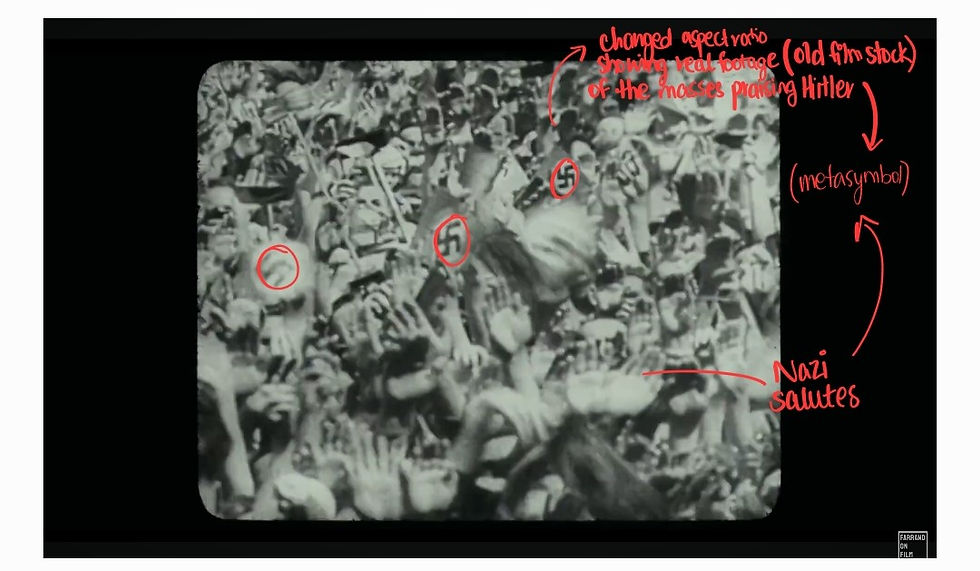
This film opening is made particularly unique with the use of cross-cutting between the tracking shot of Jojo running through town and black-and-white shots of what can be assumed to be actual footage of Nazi Germany in the 1940s (with their aspect ratio changed to what old film looked like). They highlight the exact kind of hero worshipping people did at the time providing a comparison of Jojo's behavior to that of the general public.
4)

The Nazi logos and salutes are all metasymbols used repetitively (almost overwhelmingly) by the filmmaker to emphasize the tone of the film and the adoration of the public toward Hitler. He does this using dress codes (nazi uniforms) and color codes (red and black used in Nazi propaganda) too.
The boys in this shot are used to draw comparisons with boys like Jojo and Yorkie who idolise Hitler just as these hundreds and thousands of boys do. Most of them would follow him to the ends of the earth, completely unaware of the actual reason and rationale behind it.
5)

In this shot of Jojo meeting his friend Yorkie with their salutation being the salute. They're shown to be passionate children but the filmmaker deliberately puts them in a full shot to emphasize how small they are and what a big movement they end up participating in blindly.
We see that the film uses bright and saturated colors, giving positive connotations. This is because we see the world through 10-year-old Jojo's eyes, in a world where he's in love with his country and sees it as bright and appealing. The soft beige is also inspired by old color footage of Germany. We also get yet another example of accurate depictions of the townspeople's passion and Hitler's own propaganda via posters and flyers.
6)
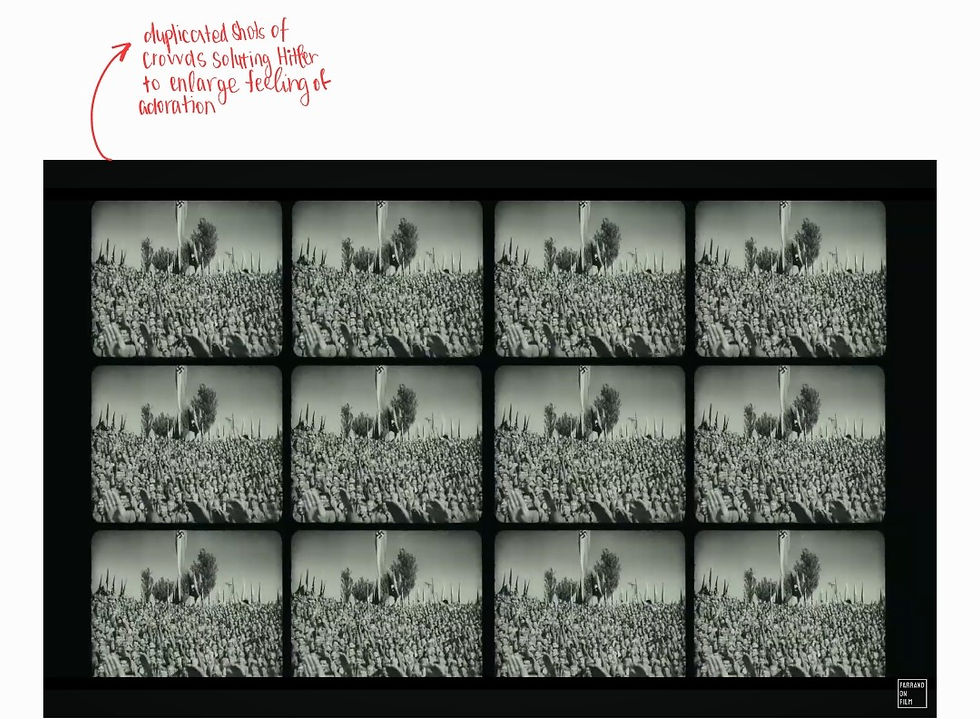
The multiplying crowd shots performing the salute is deliberately done by the filmmaker to magnify and emphasize just how much people exalted Adolf Hitler. This also foreshadows what will eventually become Jojo's main dilemma - having to confront his fantasy and blind faith (which he'll realize is futile and wrong) while the majority cluelessly indulges in patriotism.
7)

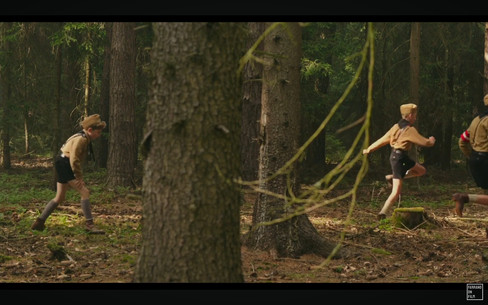
The scene ends with a main tracking shot of multiple boys running through the forest for an exercise in which Jojo falls behind and eventually stops.
This is symbolic and foreshadows how Jojo is seen as the weakest link in the group of cadets but he actually ends up being empathetic and more open minded, causing his belief system to change. He's also the slowest so while the other boys run to what'll be their eventual demise due to blind faith and hard-headedness, he will be saved from the war (its mental effects) due to his shifting beliefs.
8)

In this mid-shot, Jojo slows down to take a breath, symbolizing how he questions and reanalyzes his and everyone else's intentions in following Adolf Hitler and his campaign later in the film when he meets Elsa (the Jewish girl taking refuge in his attic), causing him to change his stance.
9)

The opening then ends with the large title card showing typography aligning with those in Nazi propaganda of that era. Red, Black and White were the main colors of the Nazi flag always featured with the same fonts in Hitler's propaganda, therefore suiting the theme of the film being WWII.
So with the final shot, that's my 9-Frame Analysis on Jojo Rabbit! This was a first, and I can't wait to do a few more.. see you in the next one!


Comments